Connaissez-vous la Rue Frantz Fanon: A Carto-biography
“Où me situer? Ou, si vous préférez: où me fourrer?” Peau noire, masques blancs

Born in colonial Martinique, educated in metropolitan France, buried (twice) in Algeria–I reduce the life of psychologist, militant thinker, and Algerian revolutionary Frantz Fanon to three territories to continue the work of David Macey and Henry Louis Gates of re-historicizing him (Macey 29). Somewhat buried in myth, Fanon’s work is often decontextualized for the purposes of a variety of national causes and evolving fields of the academy. How should you read the colonial/’
The first map, which takes some inspiration from Kathrine Swchab and National Geographic’s work on “The Thousand Streets Named After Martin Luther King Jr” as well as Neil Freeman’s “Street Grids,” is an almost heterotopic collage of streets named after Fanon from two or three areas in Algeria, France, and Martinique. I made it into a gif because I wanted to visualize the layering in a way that becomes progressively harder to read and compare. I chose only these three territories because they represent major sites in Fanon’s life as an intellectual and radical thinker–his birth place in Martinique whose racist, colonial reality features heavily in Peau noire, masques blancs; The Parisian streets and banlieues where Fanon very well might have been addressed in petit nègre or hailed and dissected by a “Tiens, un nègre” (Peau noire 125); and the Algerian infrastructure that features in Fanon’s diagnosis of “Le monde colonial [comme] un monde compartimenté” (Les damnés 28). What we find across all three territories, besides the occasion to compare their distinct historical sites/moments that make up the legacy of such an itinerant life, is a tension between official and popular narratives of history and national identity that are played out through the social relations and practices of urban memory.
Avenue du Docteur Frantz Fanon, El Djazair, Algeria
“Détruire le monde colonial c’est ni plus ni moins abolir une zone, l’enfouir au plus profond du sol ou l’expulser du territoire.” Les damnés de la terre

Frantz Fanon devoted the last 7 years or so of his life to the cause of Algerian independence–working with the FLN (Front de Libération Nationale), publishing in and editing the El Moudjahid journal, and, starting in 1960, serving as an ambassador to Ghana for the GPRA (Gouvernement Provisoire de la République Algérienne) (Britannica). Consequently, he earned his own dying wish, an Algerian, Revolutionary hero’s burial in Algerian soil twice: first a mere 600 meters off the Tunisian border on December 12, 1961 and then, on June 15 1965, he was exhumed and reburied in a martyrs cemetery in Ain Kerma (Macey 6).
Just a year after his death, Algerians would gain not only their independence but their land and the colonial infrastructures of their former oppressors as over 300,000 European colonial settlers left the territory (Grabar 389). As Henry Grabar notes, “By the summer of 1962…Fanon’s words [‘There is no colonized man who does not dream at least once a day of putting himself in the place of the colonist’] had taken on a prophetic quality: in cafes, in stores, and in apartments, Muslim Algerians were literally taking the place of pieds-noirs” (396).
In the immediate wake of this mad dash of post-colonial occupation and substitution, the FLN government quickly replaced the French colonial names of numerous squares and over 300 streets (399). It is in line with this symbolic campaign that Avenue du Maréchal de Lattre de Tassigny would be renamed Avenue du Docteur Frantz Fanon in 1963 (Macey 8). Here we see Fanon inscribed in a mixed, toponymic urban imaginary of FLN leaders (Boulevard Colonel Krim Belkacecem), more anonymous fallen heroes, and the proprietors of a popular Algerian soda brand (Rue Benzine Hamoud et Abderahmane) (Le Monde). What meaningfully links this avenue to the majority of streets named after Fanon is its proximity to various institutions of art and learning like the Cité des Sciences Alger, the Bibliothèque Nationale, and, indirectly, the Central Library of Arts and Sciences.
However, as David Macey points out, despite having two streets named after him (this one and another in Setif) as well as a school in Bab El Oued and the hospital at which he used to work in Blida, still “in 1982 a group of teachers at the University of Algiers could complain that it was still necessary to ask ‘Who is Fanon?’ because there had been nothing on either the radio or the television to mark the twentieth anniversary of his death. For the youth of Algeria, ‘Fanon’ was no more than a name inscribed in capital letters on public buildings or street signs”(Macey 8). Macey points out that this is likely due to the party agenda of the FLN that can be summed up by its prevailing motto, “only one hero: the people,” and that, following independence, evolved into and aggressively Arabic-Islamic nationalist agenda as manifest in the FLN National Charter (1965): “Algeria is one nation. The nation is not an assembly of peoples or a mosaic of disparate ethnicities” (qtd. in Grabar 400). Had Fanon lived, he would likely have no streets, schools, or hospitals named after him for, as Grabar notes, “almost all of [the rebranded streets were named] after fallen combatants…[to avoid] what might have been a contested political process of selection” (399). One must also wonder how Fanon’s identity as an Algerian would have fared in such a national climate predicated on the religious/ethnic identity of Arab Islamism. Fanon endorsed national consciousness fueled by “la mobilisation populaire,” refined by “le capital intellectuel et technique” of what he calls the “bourgeoisie nationale authentique,” but beyond what he considered the tribalism of ethnicity (Fanon, Damnés, 107, 108).
Furthermore, despite the FLN’s proclamation in the Alger Républican (1962) that its “immediate task…is to liquidate, in all its forms, colonialism as it manifests itself,” as both Grabar and Natasha Marie Llorens point out, the FLN’s infrastructural interventions hardly went beyond the superficial acts of renaming and “monumental substitution (damnés 107, 108; Grabar 391). Grabar points out the way ”the social hierarchies of the urban design prevailed in central Algiers…An Algerian bourgeoisie replaced its departing French counterpart” as “Opportunistic and well-connected families from the Casbah moved into European-style apartments of the center, and their houses were filled by an unending flow of migrants from the countryside who had been displaced by French camps” (Grabar 396). Thus, what Fanon dictated as “le minimum exigé” of decolonization in Les damnés, “que les derniers deviennent les premiers,” is far from met just as the “langage de pure violence” seemed arrested in the wake of independence in the purely symbolic process of renaming that makes up what Fanon calls the “Mésaventures de la conscience nationale” in which “le produit immédiat le plus palpable de la mobilisation populaire, ne sera en tout état de cause qu’une forme sans contenue, fragile, grossiere” (damnés 34). Algeria’s religious/ethnic reformulation of a revolutionary, national identity built on the infrastructure and, therefore, social hierarchy of the colonial regime would likely have driven Fanon into exile–but where exactly is an interesting question to return to later as we move through the other territorial profiles (107).
Rue Frantz Fanon, Bobigny, France
“Paris-ville-lumière, la Seine, les guinguettes, connaître Paris et mourir.”
Peau noire, masques blancs
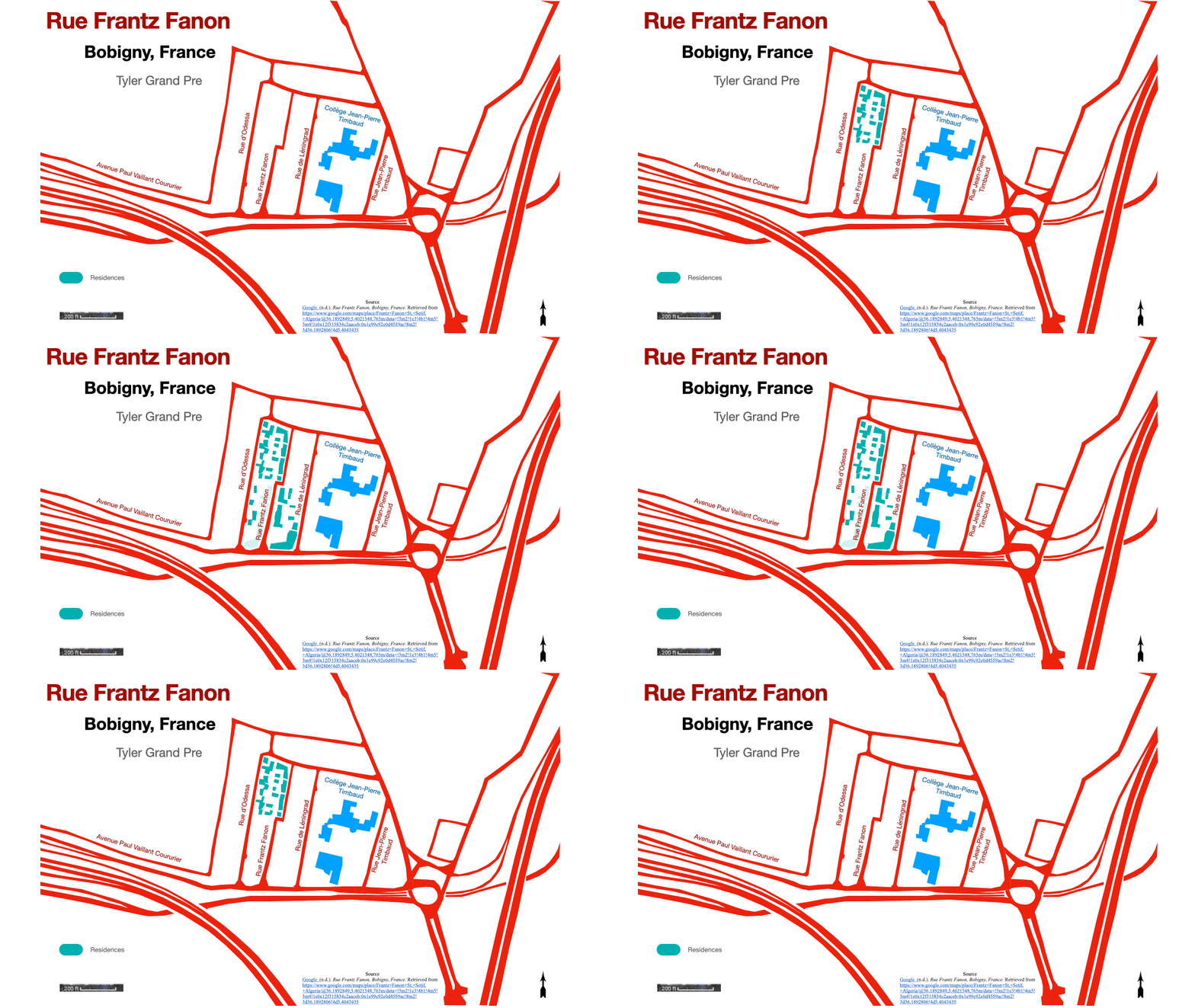
The time Fanon spent serving in the French military during WWII alongside African tirailleurs and, especially, the time he spent in metropolitan France while studying medicine and psychiatry at the university of Lyons furnished him with the material he would use to interrogate the oppressive social construction of his blackness (Britannica). In Peau noire, masques blancs, Fanon recounts the psychological trauma of repeatedly being fixed, dissected, and racialized by the language and “les regards [des] blancs” (Peau noire 129):
“‘Sale nègre!’ ou simplement: ‘Tiens, un nègre!’ J’arrivais dans le monde, soucieux de faire lever un sens aux choses, mon âme pleine du désir d’être à l’origine du monde, et voici que je me découvrais objet aux milieu d’autre objets… et l’autre, par gestes, attitudes, regards, me fixe, dans le sens où l’on fixe une préparation par un colorant. Je m’emportai, exigeai une explication…Rien n’y fit. J’explosai. Voici les menus morceaux par un autre moi réunis” (125).
Given his experiences, Fanon might be surprised to know that his name would belong to not just one but four streets in metropolitan France: Rue Frantz Fanon in Istres, Rue Frantz Fanon in Paris, Allée Frantz Fanon in Gennevilliers (perpendicular to Allée Rosa Parks), and Rue Frantz Fanon in Bobigny. The latter came about in 2014 when the developers of the “Odessa villa” finally decided upon a name for the new road cutting through their burgeoning housing complex. Parallel to streets like Rue de Léningrad and Rue Jean-Pierre Timbaud (adjacent to the so named school), the Odessa developers inscribed Fanon into a revolutionary toponymic imaginary that harkens back to the commune’s early suburban days as a part of what Tyler Stovall calls the “Paris red Belt” (Stovall 41). Mass immigration of working class persons from throughout France, especially after WWI, and the hasty construction of what became known as mal lotis made Bobigny, among other rapidly urbanized Paris suburbs, a hotbed for communist support: “Above all, the proliferation of defective allotments in the suburbs turned large areas into instant slums and deeply embittered their new residents, showing them clearly that low-cost housing built by the free market was low-quality housing” (Stovall 42; 41).
However, As George Packer notes in his article “The Other France,”
For decades a bastion of the old working class and the Communist Party, the 93 is now known for its residents of Arab and African origin. To many Parisians, the 93 signifies decayed housing projects, crime, unemployment, and Muslims. France has all kinds of suburbs, but the word for them, banlieues, has become pejorative, meaning slums dominated by immigrants. Inside the banlieues are the cités: colossal concrete housing projects built during the postwar decades, in the Brutalist style of Le Corbusier. Conceived as utopias for workers, they have become concentrations of poverty and social isolation.” (Packer “The Other France”)
Not unlike “le village nègre…[qui] est un lieu mal famé, peuplé d’homme mal famé,” the racialization and stigmatized spatialization of Bobigny go hand in hand in the discriminatory experiences of those living in 93 (damnés 30). Like the “Afrique noire [qui] se promenant dans une grande ville d’Afrique blanche” or the Algerienne during the struggle for independence who enters the European city (veiled or not), the residents of many of these cités carry the enclosures of their race and the stigmata of their space with them–especially with the recent increase of islamophobia (117). In order to find employment, residents with Arabic names will often not only change them but falsify their addresses as well to appear, at least on paper, français de souche. For instance, Packer cites one unemployed accountant who was asked by a job councellor,“You don’t have an aunt who lives in Paris or somewhere else? Because Bobigny—really?… “If you have an address in Paris, a post-office box, just to receive mail, it’s better. And then the family name, Aniba—it’s O.K., but the first name, Brahim, use ‘B.’” (Packer).
In one sense, naming a street after Fanon in Bobigny can be read as an attempt to reactivate the banlieu’s pre-islamophobic, anti-immigrant political imaginary of the “Red-belt” in association with the anti-colonial, anti-racist political legacy of the revolutionary figure. In another sense, however, when coupled with the schools adjacent to most of the streets named after him in the former and current French territories, we see an inscription of Fanon into the national narrative of French education and socialist radicalism that, like Avenue du Docteur Frantz Fanon in Algeria, acknowledges as it encloses the othered within neocolonial relations and excludes them from the dominant ethnic, national identity requisite for social and economic opportunity.
Rue Frantz Fanon, Le François, Martinique
“Pour l’instant, allons à la rencontre de l’un d’entre eux qui revient. Le ‘débarqué,’ dès son premier contact, s’affirme; il ne répond qu’en français et souvent ne comprend plus le créole.”
Peau noire, masques blancs
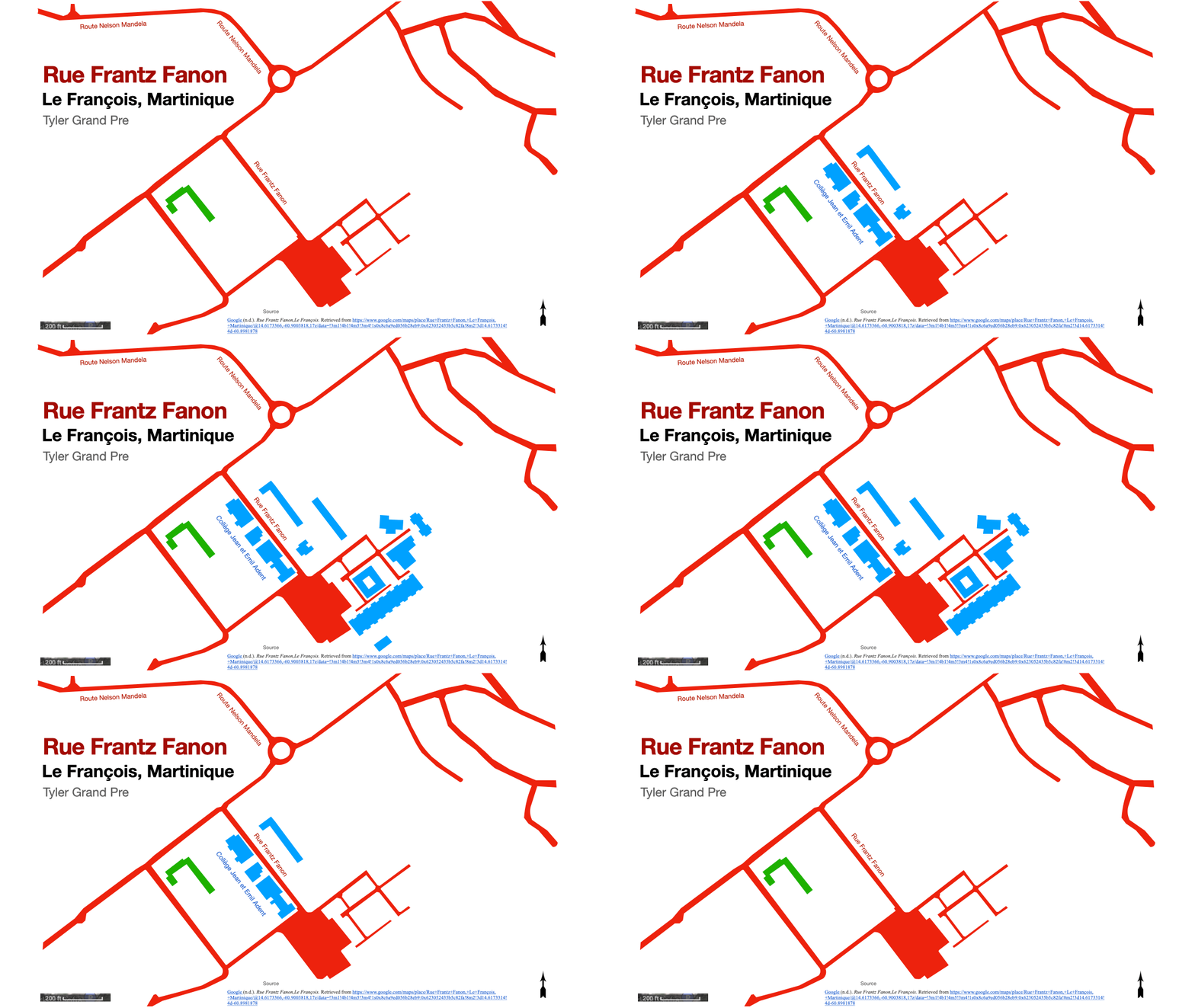
Born July 20, 1925 in Fort-de-France, Frantz Omar Fanon grew up in the racialized social hierarchy of “la békaille, la mulâtraille et la négraille” that oriented all towards the culture and race of the metropole (Peau noire 126). The primary mechanism of this socio-cultural hierarchy and orientation was, and in many ways still is, language: “le Noir Antillais sera d’autant plus blanc, c’est-à-dire se rapprochera d’autant plus du véritable homme, qu’il aura fait sienne la langue français” (57). Fanon depicts the way those who have spent time in the metropole return with an air of transformation rooted in their verbal white masks (that is, their strict use of “le français de France / le français du Français / le français français”) (59). Having mapped and unmapped, or troubled, his legacy in the colonial and post-colonial urban imaginaries of Algeria and France, I would likewise like to end with a speculative, carto-biographical (re)/(de)tour of Fanon’s legacy to his native Martinique.
Like the majority of streets named after Fanon throughout the former and current French territories, there are schools adjacent to all of them in Martinique (except for the one in Fort-de-France). As David Macey notes, “It is difficult to reconcile the existence of an ‘Avenue Frantz Fanon’ and the inevitable evocation of the wretched of the earth, with the street names that invoke a republican and abolitionist tradition (rue de la Liberté, rue Lamartine, rue Victor Hugo, rue Marat…) in such a way as to suggest that the history of Martinique began with the final abolition of slavery in 1848” (Macey 10). With this republican toponymy in mind, and the fact that Martinique, although no longer a colony, is still a department of France, Fanon’s toponymic inscription, in the case of Avenue Frantz Fanon in Ducos, on a road adjacent to Collège Asselin de Beauville and en route to Lycée générale technologique de Ducos almost rehearses (in an assimilationist mode) the psychologist’s escape from his native “ville…véritablement plate, échouée” through education.
However, to again rise to the “‘the challenge of “rehistoricizing Fanon,” Michel Leiris’ prediction, which Fanon cites in agreement, that the Creole language “paraît d’ores et déjà promis à passer tôt ou tard au rang de survivance quand l’instruction…se sera diffusée assez généralement dans les couches déshéritées de la population” has yet to come true. In fact, Creole is even taught in several of the schools adjacent to his eponymous streets such as Lycée Polyvalent La Jetée (but, interestingly enough, not the College Jeanne et Emil Adenet) (Macey 29; Peau noire 64). Furthermore, while in his time, “S’il existe un Gilbert Gratiant pour écrire en patois, il faut avouer que la chose est rare”–the poetic use of Creole has risen since the founders of Créolité penned its praise.
That being said, if we can continue the speculative invitation made by streets named after Fanon to interrogate their political geographies, recent political unrest in Martinique reveals the afterlives of slavery and colonialism that persist in a comparable colonial legacy to that of Algeria. In response to continued dominance of the béké (“the descendants of slave planters who make up only 1% of Martinique’s total population and [who] continue to control the wealth” and industry of the island, “the majority of the population (mostly black and métis) [who] simultaneously face low work wages, inflated prices on imported good, and high levels of unemployment” went on a general strike with their sister DOM Guadeloupe in 2009 (Maddox 93). Then, more recently in June of 2020, in response to President Macron’s decree that “The republic will erase no trace or names of its history, it will forget none of its works, it will tear down none of its statues’’ and during the global BLM protests, the statue of Josephine de Beauharnais in Martinique, already beheaded in 1991, was destroyed by anti-colonial activists.
Conclusion
This project is only a start to a more thorough response to the question, “Connaissez-vous la Rue Frantz Fanon?” I would like to further investigate the contexts in which the streets in Martinique were named after him as well as determine the degree to which the other Rues Frantz Fanon in France correspond to racialized communities. In scope of the project so far, I simply wish to highlight the conversation or confrontation between official and popular memory that cannot be so easily mapped as the historical facts of Fanon’s life, but it must be drawn out of the discursive tensions between the evolution of Fanon’s theoretical, political, and personal relationships to these built environments and their monumentalized national/political narratives. What Fanon would make of this experimental (un)mapping of his name is beyond me, but we can safely speculate that he would have a lot to say about the colonial, racist legacies that persist in the three major territories of his life and that, as Macey opines, “Had he lived, Fanon would still be angry” (28).
Works Cited
“Alma.” HAMOUD BOUALEM. Accessed May 1, 2021. https://www.hamoud-boualem.com/en/alma.
Bernabé, Jean. Chamoiseau, Patrick, Confiant, Raphaël. Eloge de la Créolité. Paris : Gallimard, 1993.
Fanon, Frantz. L’an V de la révolution algérienne. La Découverte, 2001.
–.Black Skin, White Masks. (1952) Translated by Richard Philcox. Grove Press, 2008.
–. Les damnés de la terre. (1961) Kiyikaat Editions. (2016)
–. Peau noire masques blancs. (1952) Kiyikaat Editions. (2015)
–. The Wretched of the Earth. (1961) Translated by Richard Philcox. Grove Press, 2004.
“Frantz Fanon.” Encyclopædia Britannica. Encyclopædia Britannica, inc. Accessed May 1, 2021. https://www.britannica.com/biography/Frantz-Fanon.
Freeman, N. (n.d.). Street grids. Retrieved March 10, 2021, from http://fakeisthenewreal.org/street-grids/ Google. (n.d.). Avenue du Docteur Frantz Fanon, El Djazair, Algeria . Retrieved from https://www.google.com/maps/place/Ave+du+Docteur+Frantz+Fanon,+El+Djazair,+Algeria
—(n.d.). Avenue Frantz Fanon, Ducos Martinique. Retrieved from https://www.google.com/maps/place/Avenue+Frantz+Fanon,+Ducos,+Martinique/@14.573191,-60.9768478,17z/data=!3m1!4b1!4m5!3m4!1s0x8c6aa01581e32dd5:0xc30042cd6d74587c!8m2!3d14.5731858!4d-60.9746538
—(n.d.). Avenue Frantz Fanon, Le Lamentin Martinique. Retrieved from https://www.google.com/maps/place/Avenue+Frantz+Fanon,+Le+Lamentin,+Martinique/@14.6146324,-60.9989442,17z/data=!3m1!4b1!4m5!3m4!1s0x8c6aa1a110f921a9:0xab790547fceb5c9e!8m2!3d14.6146272!4d-60.9967502
—. (n.d.). Rue Frantz Fanon, Bobigny, France. Retrieved from https://www.google.com/maps/place/Frantz+Fanon+St,+Setif,+Algeria/@36.1892849,5.4021548,765m/data=!3m2!1e3!4b1!4m5!3m4!1s0x12f315834c2aaceb:0x1e99c92e0d4559ac!8m2!3d36.1892806!4d5.4043435
–. (n.d.). Rue Frantz Fanon,Le François. Retrieved from https://www.google.com/maps/place/Rue+Frantz+Fanon,+Le+François,+Martinique/@14.6173366,-60.9003818,17z/data=!3m1!4b1!4m5!3m4!1s0x8c6a9ed056b28eb9:0x623052435b5c82fa!8m2!3d14.6173314!4d-60.8981878
—(n.d.). Rue Frantz Fanon, Setif, Algeria. Retrieved from https://www.google.com/maps/place/Frantz+Fanon+St,+Setif,+Algeria/@36.1892849,5.4021548,765m/data=!3m2!1e3!4b1!4m5!3m4!1s0x12f315834c2aaceb:0x1e99c92e0d4559ac!8m2!3d36.1892806!4d5.4043435
Grabar, Henry S. “Reclaiming the city: changing urban meaning in Algiers after 1962” cultural geographies Vol 2, No. 3, 2014.
Le Monde. “M. Belkacem KRIM Et Deux Autres ACCUSÉS SONT Condamnés à Mort,” April 8, 1969. https://www.lemonde.fr/archives/article/1969/04/09/m-belkacem-krim-et-deux-autres-accuses-sont-condamnes-a-mort_2437380_1819218.html.
Llorens, Natasha Marie. “The Other Battle of Algiers: Overcoming and architecture of oppression.” World Policy Journal, Vol XXXV, No. 2, Summer 2018.
Macey, David “Forgetting Fanon, Remembering Fanon,” in Frantz Fanon: A Life. London : Granta, 2000) Maddox, Camee. “‘Yes We Can! Down with Colonization!’ Race, Gender, and the 2009 General Strike in Martinique.” Transforming Anthropology, Vol 23, No 2, 2015.
Packer, George. “The Other France: Are the Suburbs of Paris the Incubators of Terrorism,” The New Yorker, August 24, 2015.
Schwab, K. (2018, July 09). Mapping the 1,000+ streets named After Martin Luther King, Jr. Retrieved March 10, 2021, from https://www.fastcompany.com/90166768/mapping-the-thousands-of-streets-named-after-martin-luther-king-jr
Woods, Mike. “Anti-Racism Protesters in Martinique Tear down Statue of Napoleon’s Wife.” RFI. RFI, July 27, 2020. https://www.rfi.fr/en/france/20200727-france-colonial-era-statues-t