addis ababa's condominiums: dual dispossessions
addis ababa's condominiums: dual dispossessions
fennet habte & ki-sang yi
Milkesa, the interviewer: Because they think they came here because they wanted to?
Lydia: At the end of the day, the farmers will just think that their land is taken from them by the government so that people from the city can be settled.
(Fathollahzadeh 2025, p. 300)
Milkesa: Most people think this is an urban area. And after 100 or 200 metres the landscape is very rural. The difference between the two is obvious.
(Fathollahzadeh 2025, p. 292)
i. IHDP ++ contested development
Addis Ababa has been the site of many visionary state-making exercises. First designated as capital city of the empire in 1898 by Emperor Menelik II and Empress Taitu, the place which was/and still is referred to as Finfinne by the indigenous Oromo inhabitants of the area has undergone restructuring and expansion under successive political regimes that sought to establish their political power and legacy in the city. Addis Ababa has the status of a self-governing city and sits within the Oromia region (Weldeghebrael 2022).
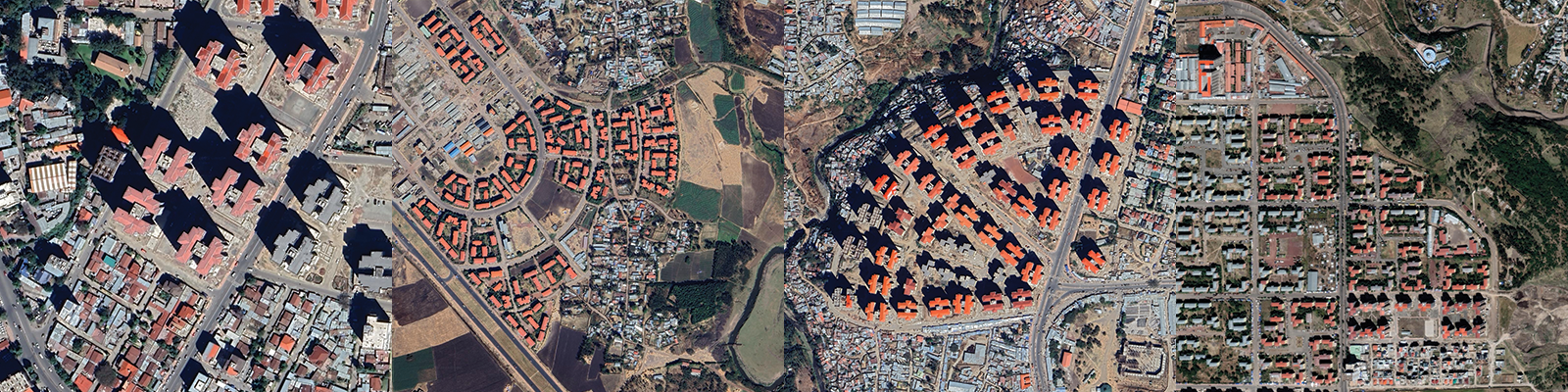
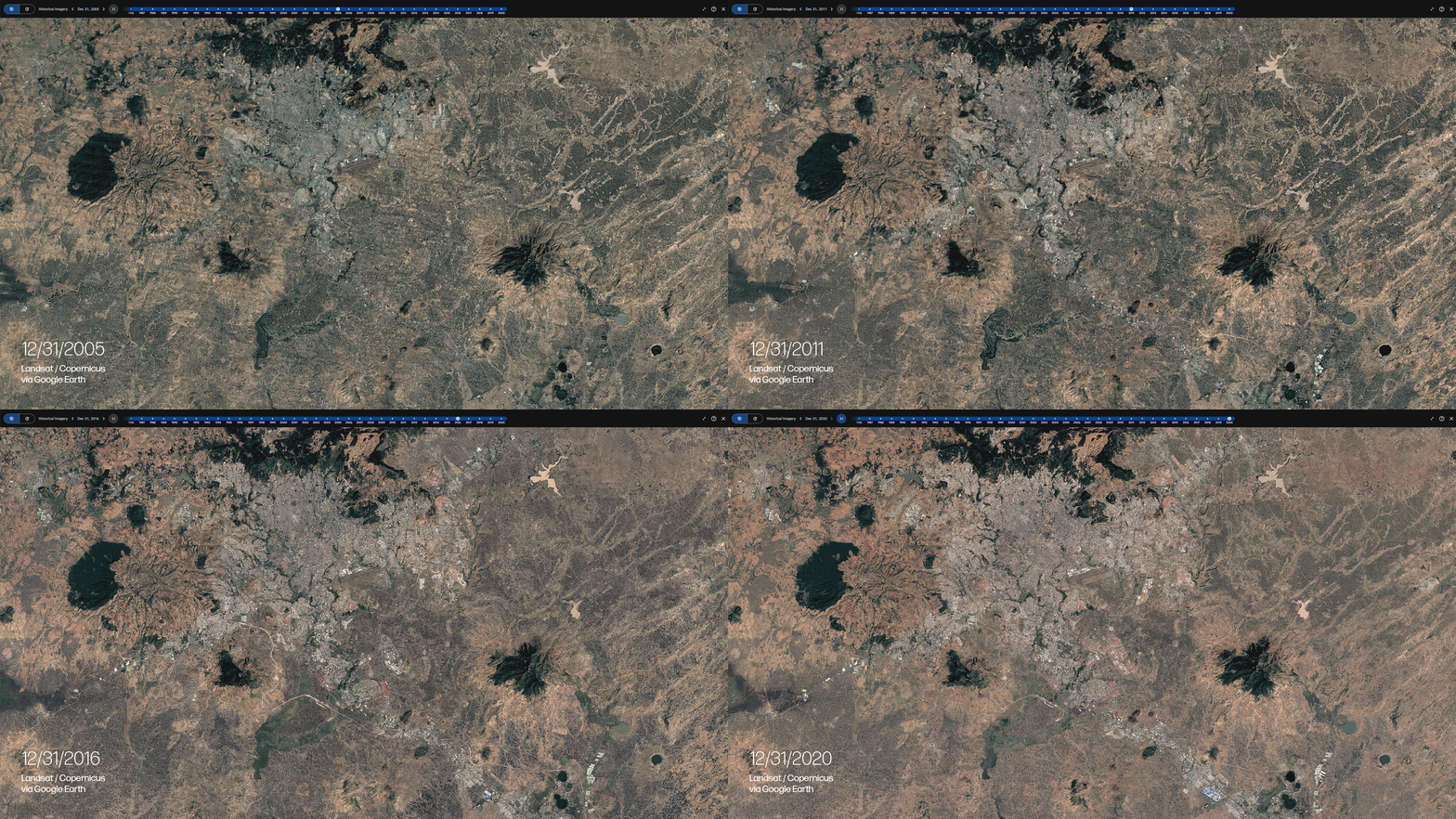
In 2006, the Government of Ethiopia announced the Integrated Housing Development Program (IHDP), an extension of the Addis Ababa Grand Housing Program (AAGHP) that was launched in 2004 in partnership with the German Technical Cooperation (GTZ). The goal of the IHDP was to address the critical housing shortage in Addis Ababa by building 400,000 condominium apartments. Simultaneously, the project aimed to beautify Addis Ababa’s inner city, address unemployment, and promote homeownership for low and middle-income households, furthering the country’s economic development goals (United Nations 2025). By 2015, the re-development of the inner-city, partially to build condominiums, but more often to allow for private re-development, has caused the demolishing of 392 ha of inner-city informal housing and the displacement of 23,151 households (UN Habitat 2017). While the first condominium projects were situated in the inner-city, eventually the project expanded to develop large-scale housing projects in what was perceived to be the ‘underutilized’ periphery of the city and adjacent farmland in Oromia. With over a hundred sites throughout the city and its periphery, the condominiums occupy 11% of Addis Ababa area - significantly changing the spatial fabric of the city and its periphery (Charitonidou 2021).
The IHDP emerged in the aftermath of the 2005 Ethiopian election, which saw a loss of votes for the EPRDF - the party that had dominated Ethiopian politics for over a decade, and large-scale protests demanding political change (Weldeghebrael 2022, p. 3). The EPRDF’s subsequent promise of infrastructure realized in the IHDP, thus served as a way to appeal to urban grievances, appease constituents, regain political legitimacy and propose an actionable vision for a prosperous, orderly city (Terrefe 2022, p. 4). In the years after the end of the cooperation with the GTZ (now GIZ), the projects’ financing solely through Ethiopian public resources has been lauded, showcasing to “other African nations that Africa can solve its own problems” (Gardner 2017).
While the project continues to be successful at increasing formal housing stock, and enabling home-ownership for low-and middle income households, research has shown that the urban poor who were deemed the primary target audience were often barely able to make the down-payment let alone their mortgage. Over the past two decades we have thus seen a phenomenon of low-income apartment owners renting to middle-class tenants to finance their mortgage, while they themselves continue to live in informal, precarious housing in the inner city (Planel & Bridonneau 2017, p. 32). Avenues into the condominiums are three-fold: Residents evicted from neighborhoods slated for demolition are given priority in purchasing a condominium, as compensation. The main avenue to home-ownership is the lottery system, that randomly allocates apartments to applicants as they become available. Lastly, those who are unsuccessful at gaining access through the lottery may choose to rent units.
relocation ++ insecurity
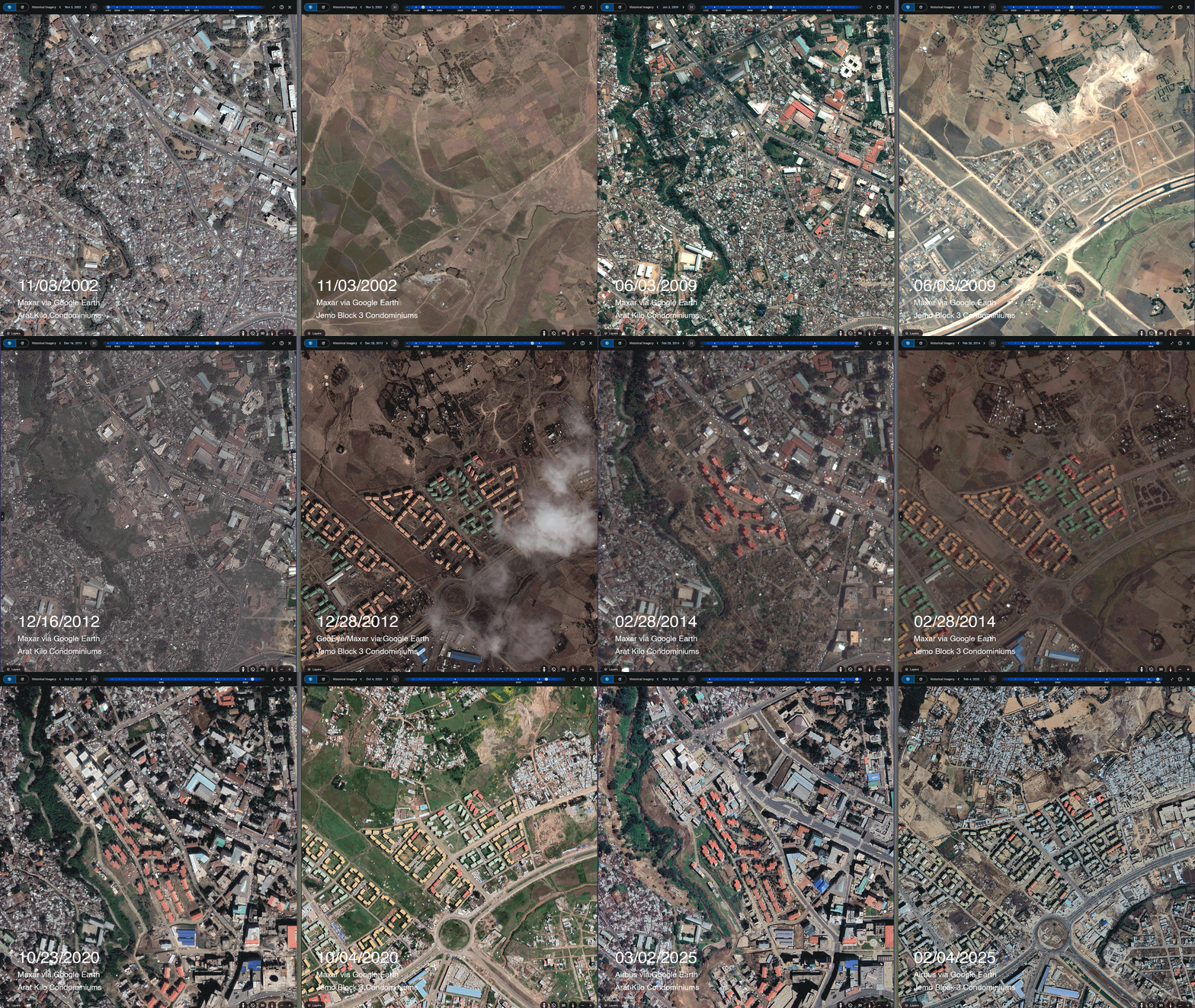
The inner-city redevelopments that sought to formalize housing and usher in a new era of modern urban development, served both to allow for easier governing of inner-city populations, deemed troublesome, unruly and hotbeds of political dissidents after the 2005 post-election protests, and created an agreeable environment for foreign- and diaspora developers in prime real estate locations (Weldeghebrael 2022, p. 4). The first inner-city site to be re-developed into an IHDP site was in the Lideta neighborhood. According to government officials it was selected due to the belief that “there was a huge concentration of Coalition for Unity and Democracy (CUD) 2005 election campaigners and subsequent protest mobilizers”. Relocations of residents of informal inner-city settlements were conducted with little community input, at times purposefully separating inner-city communities, who had been deemed sites of opposition protest, scattering them across five to twelve different condominiums at the city’s peripheries, severing existing social networks (Weldeghebrael 2022, p. 6). The strategic spatial dispersion of former inner-city residents deemed troublesome allowed the IHDP to act as a mechanism of enacting control and repress potential future counter-government organizing.
In a study of Jemo condominiums, which house several residents evicted from the central Arat Kilo neighborhood, Planel & Bridonneau highlight the tension between a sense of security through formal home-ownership and financial insecurity due to high mortgage costs.
Getenet, owns a condominium in Jemo after being evicted from his rental house (kebele bet) in Arat Kilo.
(Planel & Bridonneau 2017, p. 36)
New condominium residents experienced a loss of social networks and faced increased time and cost barriers for accessing work opportunities in the city center. The condominium sites themselves, resembling post-war European housing blocks, were built with little regard to common cultural use patterns and fostering community gathering. While some condominium sites have developed into lively and bustling neighborhoods, many residents report a sense of loneliness and anonymity from life in the condominiums (Planel & Bridonneau 2017, p. 39).
ii. addis urbanism ++ aspirations of modernity
Older informant, relocated from the city-center.
(Abebe & Hesselberg, 2015, p. 557)
Prime minister Abiy’s current Dubai-like development attempts at beautifying the inner-city are aimed at attracting foreign capital and diaspora involvement, cementing Addis Ababs legacy as diplomatic capital of Africa (Gardner 2019). Historic informal inner-city neighborhoods stand in the way of the desired vision for Addis Ababa and must therefore give way to skyscrapers and luxury projects (Di Nunzio 2022, p. 5). While this can be understood as a move away from the EPRDF’s pro-poor framing of urban development, it is important to note that despite the pro-poor framing of the IHDP when it was launched in 2005, it still caused the displacement and disposession of thousands of inner-city residents and rural residents in the city’s periphery. Dispossession is thus a continuing modus-operandi of consecutive political regimes. In the case of Addis, it goes hand in hand with the impossibility of criticizing construction projects that promote development. The idea that cities must be particularly modern and globally connected is presented as an indisputable truth, whereby participatory consultations with those affected or considerations of the consequences of displacement and resettlement are dismissed as irrelevant (Hollands 2008). The justification of displacement as a necessary evil for development then and now made way for lucrative industrial and real-estate development.
Fanos, resident in a village across Akaki river: No one hates urbanisation as long as we benefit, or our children benefit. We as well as our children would love to change. We didn’t say Finfinnee should not expand, but our needs should be noted.
Milkesa: How do you see the growth of the city?
Dagne, a resident in a village across Akaki river: We all know that a city has to grow vertically. But when it expands horizontally at such a rate, we should understand that there is something wrong. Even if it grows horizontally, it should have some benefit for the population it displaces. But we get nothing from it.
(Fathollazadeh 2025, p. 292)
Established ideas of what is understood as a modern, progressive and desirable city diametrically contrast African cities. These are positioned as “unplanned, informal, overpopulated, over- or wrongly urbanized, and behind” (Faria & Whitesell 2021, p. 6). In response, imitating globally circulating ideas of a modern city holds the promise of catching up to Western metropolises (Angélil & Hebel 2010, p. 14). When critiqued it is often justified by the response “does Africa not deserve shiny new cities?” and the claim that it is now Africa’s turn to build prosperous and modern cities (Côté-Roy & Moser 2018). The Ethiopian and regional governments in Addis Ababa view infrastructure as a harbinger of change, modernization, and social progress (Larkin 2013, p. 332). It can be argued that the IHDP is a mechanism through which Ethiopia–and in particular, Addis Ababa ”can take part in a contemporaneous modernity by repeating […] a common visual and conceptual paradigm of what it means to be modern” (Larkin 2013, p. 333).
iii. expansion ++ disposession
(Gardner 2017)
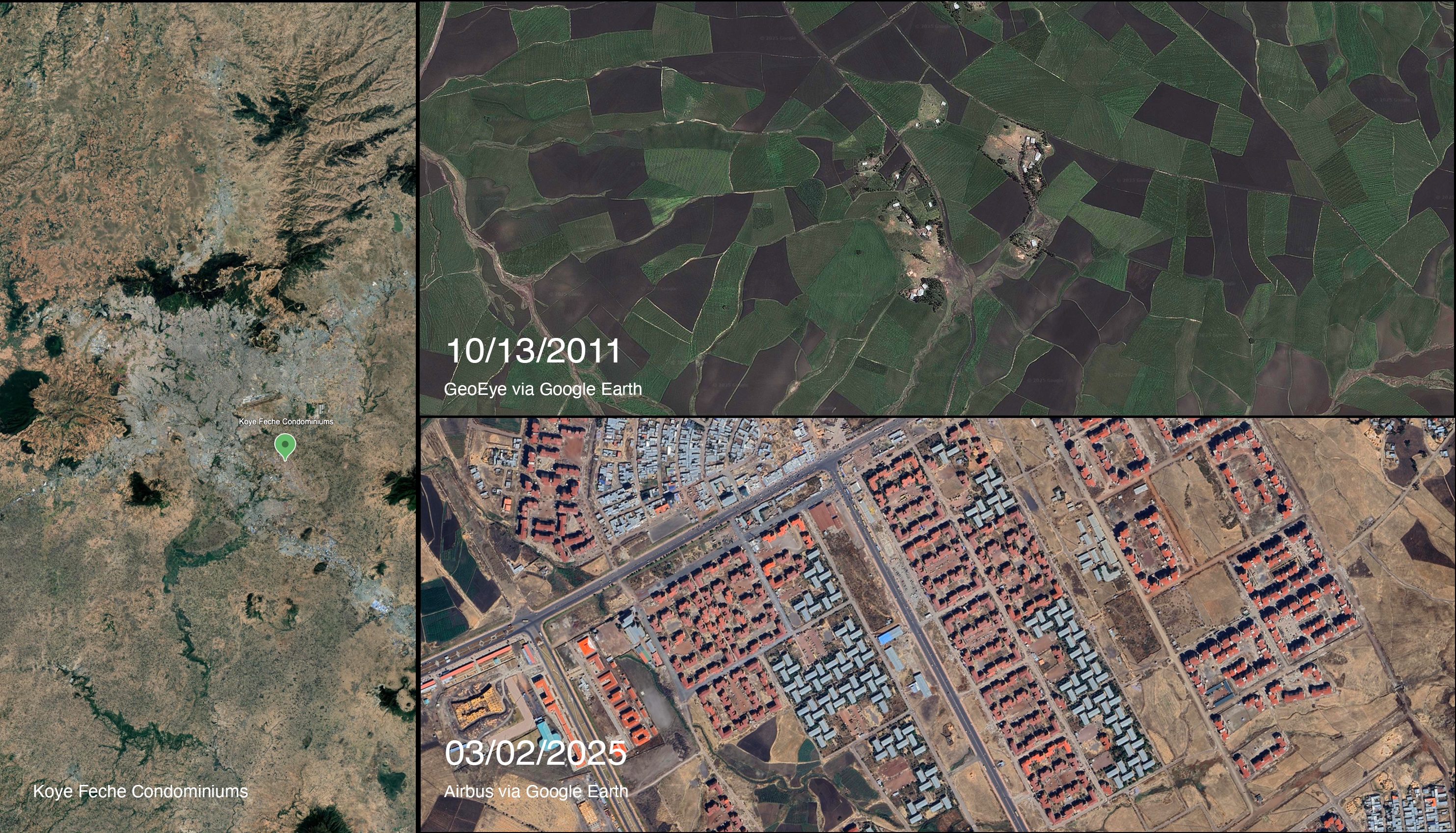
Poor inner-city residents, who have to make way for new construction projects to upgrade the coveted city center, are resettled on the outskirts of the city, where they fulfill a dual role of dispossessed and dispossessors of Oromo land (Di Nunzio 2022, p. 4). In their discussion of frontier-making in Addis Ababa’s periphery Debelo & Soboka discuss peri-urban frontiers as a liminal space between the urban and the rural. The rural here is “perceived as a space that can be “discovered, claimed, tamed, settled, transformed” to be economically productive and culturally modernized by those who claim to be authorized to re-order and dominate the space” (Prout and Howitt 2009, p. 397; Debelo & Soboka 2022, p. 710). In addition, Addis Ababa’s peripheral frontier is conceptualized as “full of resources but empty of people” (Korf et al. 2015 via Debelo & Soboka 2022). Thus legitimizing farmers’ dispossession for more ‘productive’ land-uses in the form of condominiums.
A dispossessed farmer in Oromia.
Wayessa 2020, p. 71)
However, Addis Ababa’s expansion does not go unchallenged. The announcement of a new masterplan in 2014, which sought to incorporate adjacent towns and villages in Oromia into Addis Ababa proper, was met with massive protests across Oromia state. Protesters fought for a suspension of the plan, which they saw as a tool to legalize the further dispossession of farmers surrounding Addis Ababa. While the masterplan was suspended in January of 2016, protests continued in the following months and reached international attention when during and following ‘Ireecha’ celebrations (Oromo thanksgiving) several hundred were killed due to violent government intervention (Terrefe 2022, p. 9). The subsequent political pressure led Prime Minister Hailemariam Desalegn to resign, who was replaced by Prime Minister Abiy Ahmed in 2019 - heralded as the harbinger of a new political era.
iv. conclusion
The IHDP has undoubtedly brought with it rapid transformation, both in Addis Ababa’s spatial footprint and in the way residents of the city and its rural periphery experience dispossession, condominium living, and urbanization. The simultaneous transformation of urban space in the center of the city and its newly commodified periphery highlights the dual role that residents evicted from the inner-city hold in peripheral condominiums, as being dispossessed and acting as dispossessor.
Tying Addis Ababa’s urban development to larger continental, aspirational urbanisms, shows how modernization processes in the center and periphery both on the local level and the global level are inextricably linked. The case of Addis Ababa, challenges us to search for forms of equitable urban development and question the narrative of dispossession as merely a byproduct of development. Instead, we are encouraged to look at how dispossession and displacement are created, why they are maintained and how they manifest spatially.
v. references
Abebe, Gezahegn, and Jan Hesselberg. 2015. “Community Participation and Inner-City Slum Renewal: Relocated People’s Perspectives on Slum Clearance and Resettlement in Addis Ababa.” Development in Practice 25 (4): 551–62. https://doi.org/10.1080/09614524.2015.1026878.
Angélil, Marc, and Dirk Hebel. 2010. Cities of Change : Addis Ababa : Transformation Strategies for Urban Territories in the 21st Century. Basel ; Boston : Birkhäuser. http://archive.org/details/citiesofchangead0000unse.
Wayessa, S. Bula. 2020. “‘They Deceived Us’: Narratives of Addis Ababa Development-Induced Displaced Peasants.” International Journal of Sociology and Anthropology 12 (3): 67–75. https://doi.org/10.5897/IJSA2020.0862.
Charitonidou, Marianna. 2022. “Housing Programs for the Poor in Addis Ababa: Urban Commons as a Bridge between Spatial and Social.” Journal of Urban History 48 (6): 1345–64. https://doi.org/10.1177/0096144221989975.
Côté-Roy, Laurence, and Sarah Moser. 2019. “‘Does Africa Not Deserve Shiny New Cities?’ The Power of Seductive Rhetoric around New Cities in Africa.” Urban Studies 56 (12): 2391–2407. https://doi.org/10.1177/0042098018793032.
Debelo, Asebe Regassa, and Teshome Emana Soboka. 2023. “Urban Development and the Making of Frontiers in/from Addis Ababa/Finfinne, Ethiopia.” Journal of Asian and African Studies 58 (5): 708–24. https://doi.org/10.1177/00219096211069647.
Di Nunzio, Marco. 2022. “Evictions for Development: Creative Destruction, Redistribution and the Politics of Unequal Entitlements in Inner-City Addis Ababa (Ethiopia), 2010–2018.” Political Geography 98 (October):102671. https://doi.org/10.1016/j.polgeo.2022.102671.
Faria, Caroline, and Dominica Whitesell. 2021. “Global Retail Capital and Urban Futures: Feminist Postcolonial Perspectives.” Geography Compass 15 (1): e12551. https://doi.org/10.1111/gec3.12551.
Fathollahzadeh, Nafis. 2025. “8000 Cities: Beyond the Contested Urbanisation of Addis Ababa.” City 29 (1–2): 289–303. https://doi.org/10.1080/13604813.2024.2395123.
Gardner, Tom. 2017. “‘Addis Has Run out of Space’: Ethiopia’s Radical Redesign.” The Guardian, December 4, 2017, sec. Cities. https://www.theguardian.com/cities/2017/dec/04/addis-ababa-ethiopia-redesign-housing-project.
———. 2019. “‘This Is Dubai Now’: Nobel-Winning PM’s Plan to Transform Addis Ababa.” The Guardian, October 16, 2019, sec. Cities. https://www.theguardian.com/cities/2019/oct/16/this-is-dubai-now-nobel-winning-pms-plan-to-transform-addis-ababa.
Hollands, Robert G. 2008. “Will the Real Smart City Please Stand up?: Intelligent, Progressive or Entrepreneurial?” City 12 (3): 303–20. https://doi.org/10.1080/13604810802479126.
Larkin, Brian. 2013. “The Politics and Poetics of Infrastructure.” Annual Review of Anthropology 42 (1): 327–43. https://doi.org/10.1146/annurev-anthro-092412-155522.
Planel, Sabine, and Marie and Bridonneau. 2017. “(Re)Making Politics in a New Urban Ethiopia: An Empirical Reading of the Right to the City in Addis Ababa’s Condominiums.” Journal of Eastern African Studies 11 (1): 24–45. https://doi.org/10.1080/17531055.2017.1285105.
Terrefe, Biruk. 2022. “Infrastructures of Renaissance: Tangible Discourses in the EPRDF’s Ethiopia: Infrastructures de Renaissance: Discours Tangible Dans l’Ethiopie de Le FDRPE.” Critical African Studies 14 (3): 250–73. https://doi.org/10.1080/21681392.2022.2039731.
UN-Habitat. 2017. “The State of Addis Ababa: The Addis Ababa We Want.” https://unhabitat.org/sites/default/files/download-manager-files/State%20of%20Addis%20Ababa%202017%20Report-web.pdf.
United Nations Public Service Innovation Hub. 2015. “United Nations Public Service Award Winners: Integrated Housing and Development Program (IHDP).” United Nations. 2015. https://publicadministration.un.org/unpsa/innovation-hub/Winners/2015-Winners/Integrated-Housing-and-Development-Program.
Weldeghebrael, Ezana Haddis. 2022. “The Framing of Inner-City Slum Redevelopment by an Aspiring Developmental State: The Case of Addis Ababa, Ethiopia.” Cities 125 (June):102807. https://doi.org/10.1016/j.cities.2020.102807.
datasets
Google Maps. n.d. “Condominiums in Addis Ababa, Ethiopia.”
“Condominiums in Addis Ababa, Ethiopia Retrieved from Https://Planet.Osm.Org.” 2025. Geolocations. https://www.openstreetmap.org/.