On the ground, as it happened
In December 2024, Bashar Al-Assad’s government collapsed amid a sudden and unexpected advance of anti-government forces. The Syrian Civil War’s front lines had remained relatively unmoved for years, so it came as a surprise that anti-government forces managed to capture Aleppo with little resistance. Many analysts speculated that cities like Daraa and Hama could be captured next, but few outside observers predicted this offensive would lead to the immediate collapse of the regime.
Due to the unexpected nature of these events, many international news agencies were slow to notice their significance. By December 1, Syrian rebel advances were peripherally mentioned in coverage of Israel’s war in Gaza. Still, it was only on December 6th, after the city of Homs was captured from the Assad regime, that major agencies began dedicated coverage of Syria.
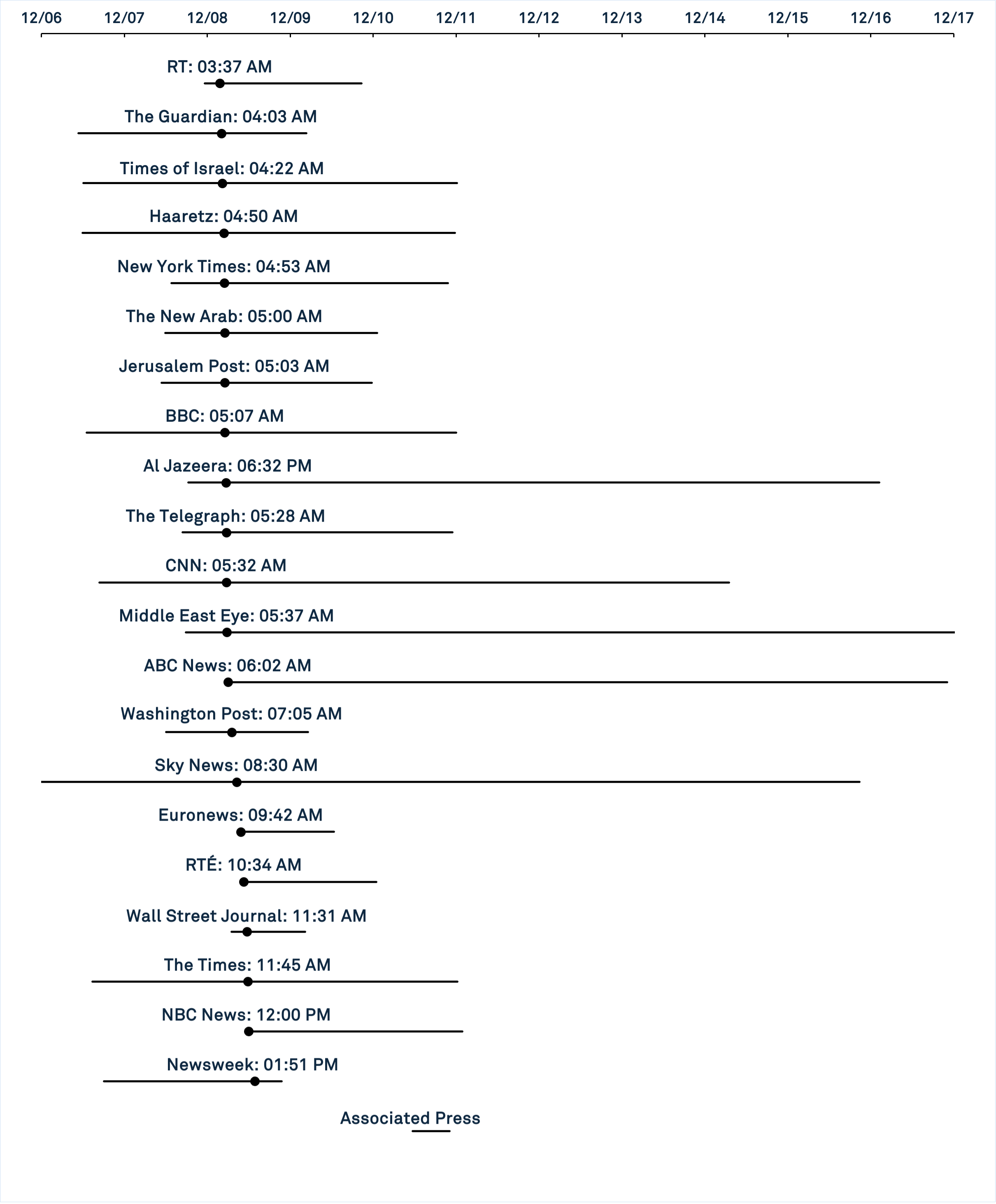
Live blogs of news agencies, and timestamped post announcing the “End of the Assad regime”
This project analyzes the journalistic methods used to rapidly expand coverage of the fall of the Assad regime and the city of Damascus. I wish to examine the reliance of reporting on various forms of OSINT (Open-Source Intelligence), and on constructing an authoritative voice amid uncertainty “on the ground.”
OSINT and the Analysis Industry
Journalism under the Assad regime was heavily regulated. All Syrian journalists had to be licensed with the state news agency, and international correspondents were prohibited from entering the country. These obstacles led to an emphasized use of OSINT in Syria coverage. With the competing pressures of the need for accuracy and the desire to break stories first, mainstream news agencies heavily utilized open-source methods in their reporting.
For example, even though Reuters, the Associated Press, and Agence-France Presse manage their own well-respected wires to other newsrooms, all three relied on regime-run television, anonymous Syrian contacts, and social media channels—in other words, the same sources as any freelance investigative journalist.
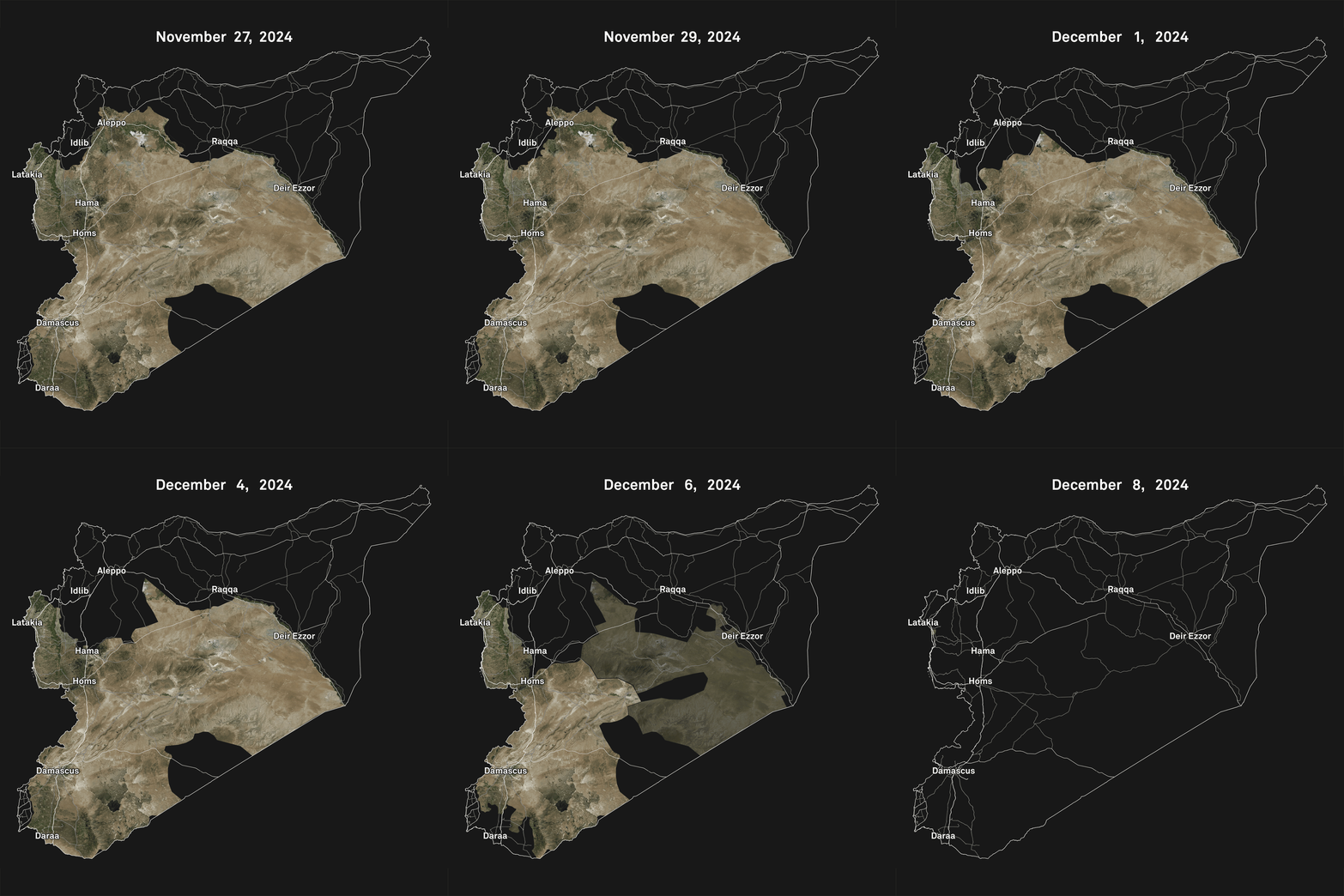
Regime control of Syria, November 27 – December 8, 2024, according to LiveUAMap.
Another example is the use of LiveUAMap, a mapping platform known for its exhaustive gathering of internet sources to map war zones precisely. The LiveUAMap for the Syrian Civil War has been operating continuously for nearly a decade, and all international news agencies derived their maps of Syria’s contested territories from this platform. There becomes a reliance on a curated form of OSINT by these agencies, who cannot contest the accuracy of the information for themselves.
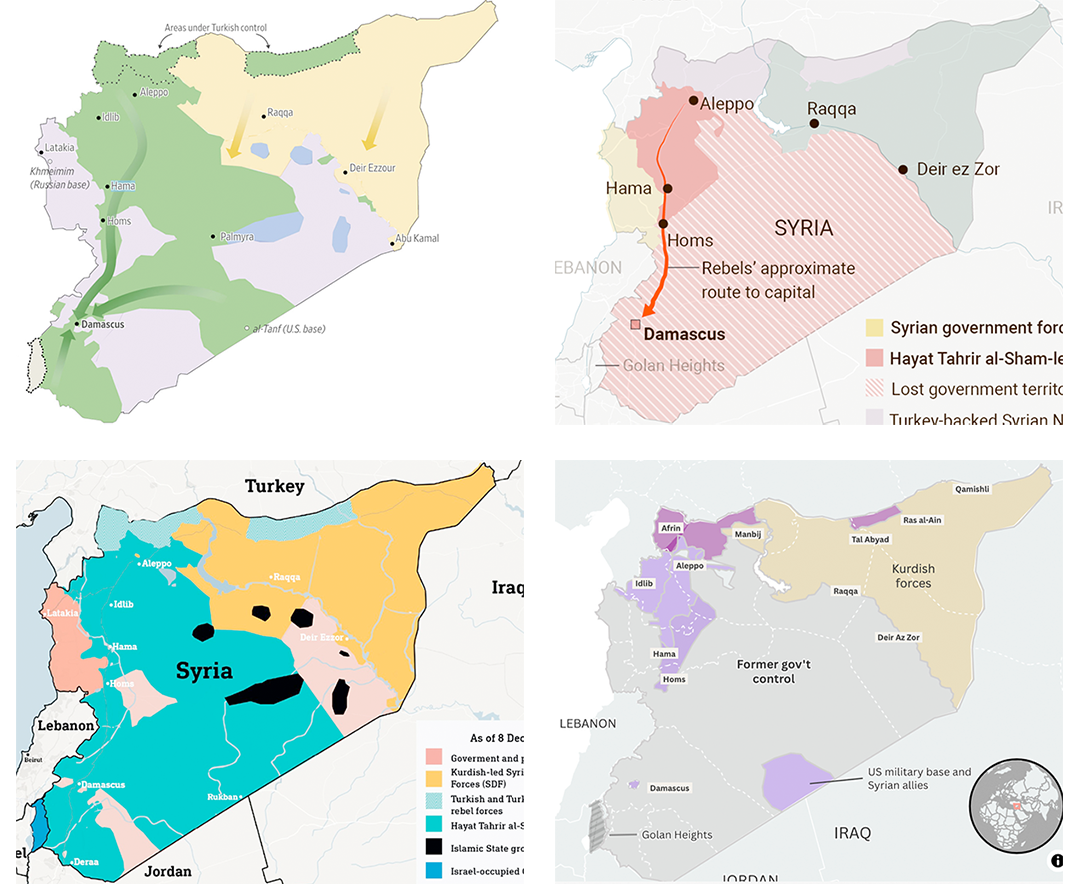
Maps of Syria derived from LiveUAMap and modified with other data sources. Clockwise from top left: Wall Street Journal, Times of London, euronews, Middle East Eye.
Live Blogs & Constructing Narratives
There is a tension observable in the coverage of the events in Syria. Journalists are responsible for vetting sources of information “on the ground” before reporting on them, but they are also pressed to cover the news “as it happens,” i.e., in an immediate and timely manner. In a context like Syria, the desire to cover these extraordinary events competes with journalistic responsibility to ground-truth what one is reporting.
As this is impossible in such circumstances, a kind of metaphorical ground-truthing has to occur; rather than establish facts on the ground, agencies have created “verification teams,” such as BBC Verify, Al Jazeera’s Sanad Verification Agency, and The New York Times’ Visual Investigations. These teams sift through OSINT—usually sources already believed by the main reporters to be accurate—and analyze their possible validity through various techniques.
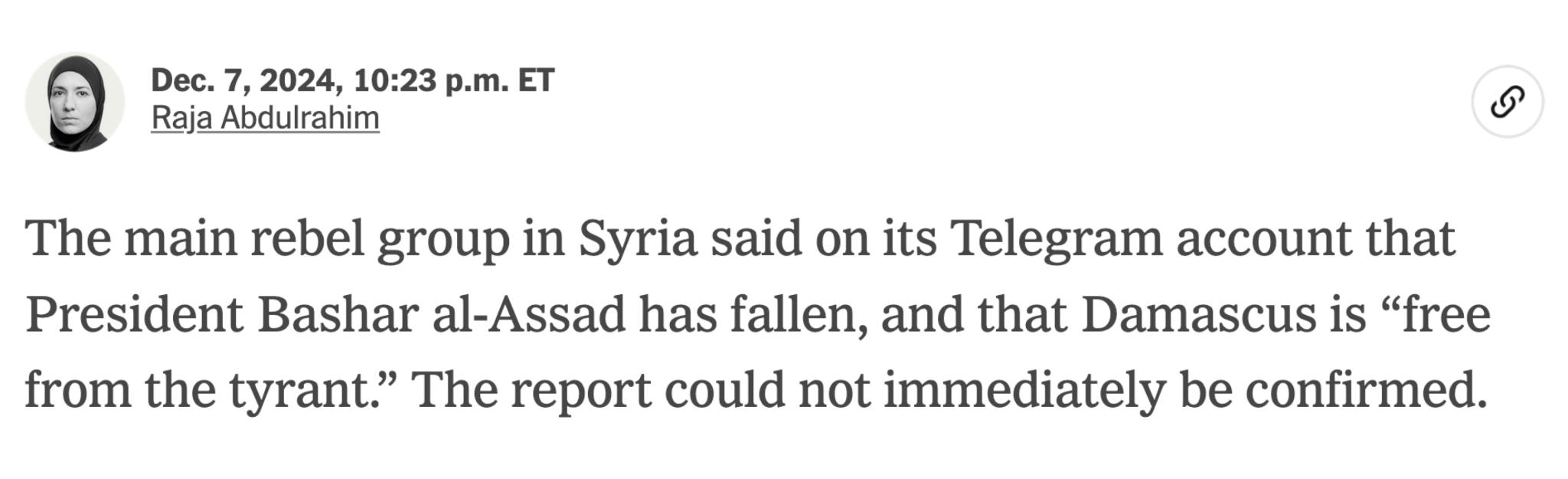
New York Times reporting on the fall of the Assad regime.
Like in coverage of the war in Gaza, many agencies used the now-ubiquitous “live blog” format for their reporting. Live blogs are a relatively recent media format, having been first implemented primarily to cover the Arab Spring protests better as they unfolded around 2011. They consist of a feed of chronologically-sorted “blogposts” that work similarly to social media posts, and can include attached media such as photos and videos, or can embed things like Twitter posts or interactive maps. These blogs give the impression of a more intimate journalistic experience, allowing readers to receive up-to-the-minute reporting without waiting for full articles to be edited and published. Yet the blogs also project an authoritative narrative, as these blogs include shorter blurbs of reporting and links to longer articles across the website as well, keeping the reader on a particular editorial track.
Interestingly, in the case of Syria, none of these thorough and well-populated live blogs (of which at least 22 covered Syria) were authored by people inside Syria. This layer of disconnection is very apparent in the technical language used in nearly every paragraph written in the blogposts: “according to videos on social media” … “A Syrian war monitor told Reuters” … “as stated on HTS’s official Telegram channel”, etc.
Conclusion: The Race to the News
Syria Lebanon border pic.twitter.com/7vErV7mLP7
— Zeina Khodr (@ZeinakhodrAljaz) December 8, 2024
Al Jazeera’s Zeina Khodr at the Syria-Lebanon border, 10:34am, December 8, 2024.
International news agencies arrived after the crucial moment in Syria, according to their own metrics. The end of the regime was declared by these live blogs, on average, around 6:00am Damascus time, yet the Lebanese authorities had declared the prior day that the Syrian-Lebanese border would remained closed until 8:00am. Zeina Khodr’s clip of Syrians tearing down Assad regime flags at a border checkpoint was not uploaded to X until 10:30am, and it would be three more hours until an international journalist was reporting from Damascus.
Yet, the desire of these foreign journalists to report “live from Damascus” speaks more to establishing a narrative authority than verifying their prior claims about the end of the regime. They raced to Damascus to “see for themselves” (in other words, to see for the television audience) that Syria had been liberated and that Assad’s palaces and prisons were both emptied.
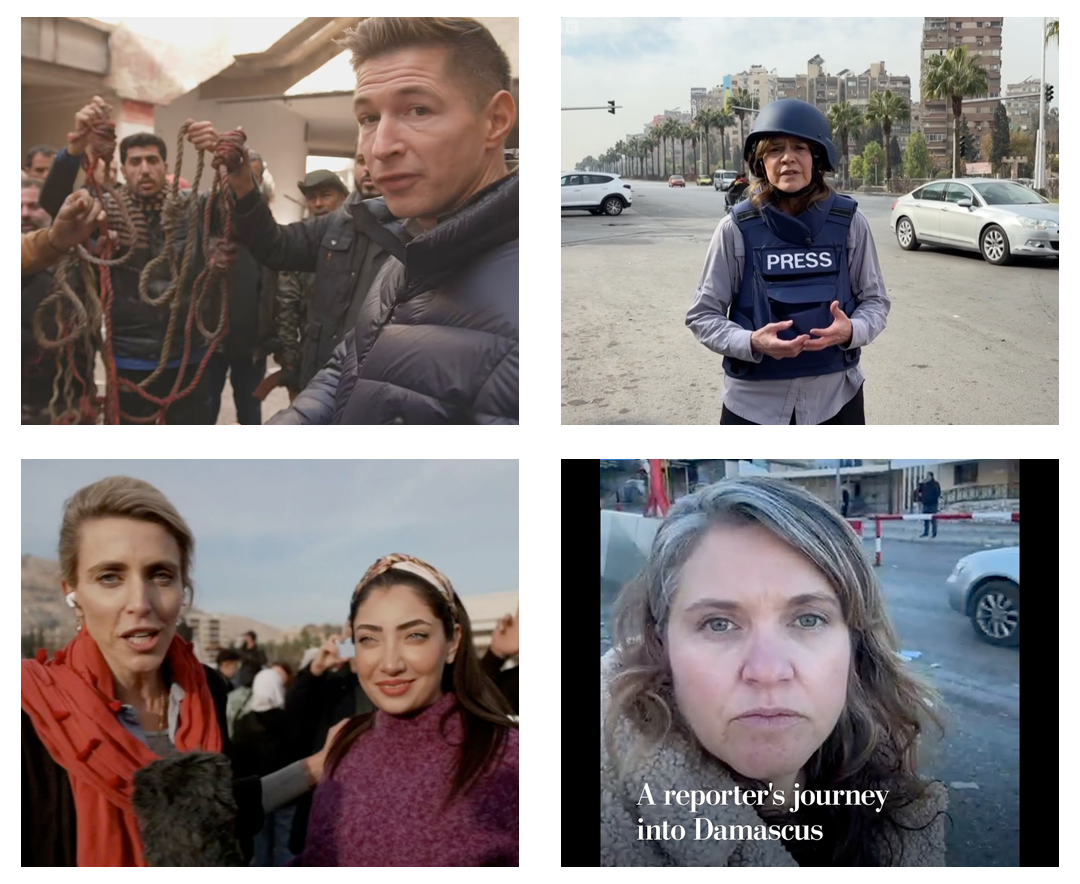
Initial broadcasts reporting live from Damascus. Clockwise from top left: James Longman with ABC, Barbara Plett-Usher with BBC, Loveday Morris with Washington Post, Clarissa Ward with CNN.